Calcium scaling: how to prevent it with saturation control
Prevent scale by holding pH at 7.2 to 7.8, calcium at 250 to 400 ppm, and alkalinity at 80 to 120 ppm, and by managing evaporation and fill water hardness.
Prevent scale by keeping pH at 7.2 to 7.8, calcium hardness at 250 to 400 ppm, and alkalinity at 80 to 120 ppm, and by limiting evaporation and topping up with softer water. Descaling costs $40 to $1,200; prevention is the chemical budget.
- pH target
- 7.2 - 7.8
- Calcium hardness
- 250 - 400 ppm
- Alkalinity
- 80 - 120 ppm
- Removal cost if ignored
- $40 - $1,200
Some links on this page are affiliate links.If you buy through them we may earn a commission at no extra cost to you. We do not accept payment for rankings. Read the full disclosure.
Calcium scale is preventable, and the prevention is arithmetic rather than a product. Hold pH at 7.2 to 7.8, calcium hardness at 250 to 400 ppm, and total alkalinity at 80 to 120 ppm, and the water stays close to saturation instead of depositing calcium on the tile. Descaling costs $40 to $1,200; the prevention is the chemical budget you already have.
Why scale forms
Calcium carbonate has a solubility limit. Below it, calcium stays dissolved. Above it, the excess comes out of solution and bonds to the nearest surface.
Three things push water over the limit: high pH, high calcium hardness, and high alkalinity. A fourth, evaporation, concentrates all three at the waterline, which is why scale appears there first.
The numbers and what each does
| Parameter | Target | Effect when high |
|---|---|---|
| pH | 7.2 - 7.8 | Deposits scale at the waterline |
| Calcium hardness | 250 - 400 ppm | Saturates the water |
| Total alkalinity | 80 - 120 ppm | Pushes pH up and holds it there |
| Water temperature | Normal range | Warm water holds less calcium |
| Evaporation | Minimised | Concentrates minerals at the surface |
pH is the lever with the most effect and the fastest movement. A pool at pH 8.2 will scale even with moderate calcium, and the same pool at 7.4 will not.
The saturation relationship
The practical rule is that pH and calcium hardness trade against each other. Water at 400 ppm calcium and pH 7.4 is usually stable; water at 250 ppm and pH 8.0 is not.
That is why lowering pH is the first response to a scaling pool, and why raising calcium without watching pH can cause the problem it was meant to prevent.
Alkalinity is the buffer that keeps pH from drifting. A pool at 60 ppm alkalinity will swing in pH and scale unevenly, because the pH is not held at a stable value.
Evaporation and top-up water
Every gallon that evaporates leaves its minerals behind. Topping up with hard water adds more calcium, and the concentration rises season by season.
That is how a pool that tested at 300 ppm in spring reaches 500 ppm by autumn without any chemical being added. The water did not change; the volume did.
A cover is the cheapest fix. It cuts evaporation, which cuts both the concentration effect and the top-up volume. A partial drain and refill with softer water is the correction when hardness is already high.
Testing and correcting
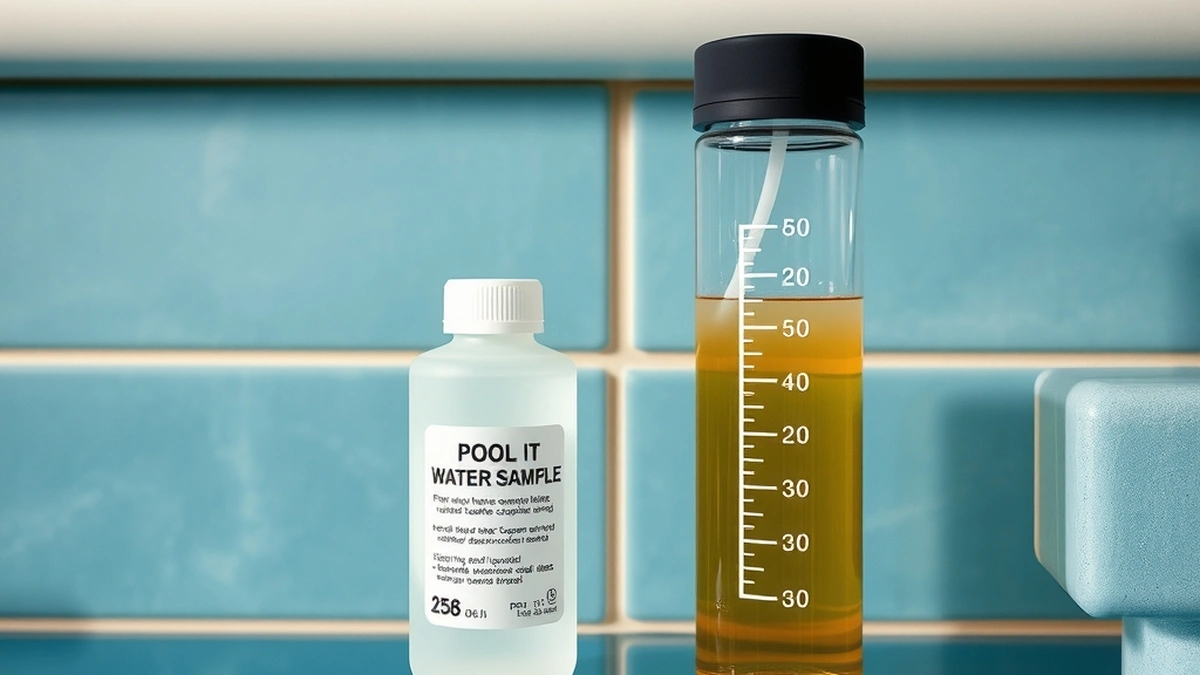
Test pH and chlorine twice a week in season. Test calcium hardness and alkalinity monthly, and after any significant top-up.
To lower calcium, dilute: drain 20 percent of the pool and refill with softer water, which drops the concentration by roughly the same proportion. To lower pH, add acid in small doses and retest. To lower alkalinity, use acid and aeration rather than a single large dose.
Never chase two numbers at once. Correct pH first, then alkalinity, then calcium, retesting between each. A pool that is corrected in three steps over three days is more stable than one corrected in a single afternoon, because each correction moves the others.
The pool surface is the visible scale, but the equipment scale is the expensive one. A heater element runs hotter than the pool water, and calcium comes out of solution faster at higher temperature, so the element collects a crust that insulates it from the water it is meant to heat.
That shows up as a heater that runs longer for the same temperature rise, and eventually as a rumbling or knocking sound. Descaling a heater is $150 to $600, and a neglected one fails instead.
A salt cell scales on the electrodes in the same way. The cell loses output, the controller reports low chlorine, and the owner adds more salt, which does not help. Cleaning is part of maintenance; replacement is $200 to $500.
Check both whenever the pool surface shows scale. The same water is circulating through them.
Equipment scale, and six habits that prevent it
- Test pH twice a week and correct in small steps.
- Hold alkalinity at 80 to 120 ppm so pH stays stable.
- Check calcium hardness monthly and dilute when it passes 400 ppm.
- Cover the pool when it is not in use.
- Top up with the softest water available.
- Wipe the waterline tile weekly before scale bonds.
Step six is the one that buys time. Scale that is wiped off while it is a film does not become a crust, and the waterline is where it starts. A cheap tile brush and five minutes at the weekend is the lowest-cost intervention in the whole routine, and it is the one most owners never do.
What prevention saves
A full descale at $300 to $700, or a drain and blast at $600 to $1,200, is the cost of a year or two of ignored chemistry. The prevention is a test kit, a cover, and a few dollars of acid.
There is also the equipment line. A scaled heater loses efficiency and a scaled salt cell stops working, and those repairs are $150 to $600 each. The same water causes all of it.
The short version
Scale is supersaturation made visible. Hold the three numbers, cover the pool, dilute when hardness climbs, and wipe the tile. The removal methods are in calcium scaling: repair options, the prices are in calcium scaling: what a fix costs, and the early symptoms are in calcium scaling: warning signs.
Frequently asked questions
How do I stop calcium scale forming?
Hold pH at 7.2 to 7.8, calcium hardness at 250 to 400 ppm, and total alkalinity at 80 to 120 ppm. Scale forms when the water is supersaturated, and those three numbers are what decide saturation.
Does high calcium hardness cause scale?
It is one of the causes. Scale needs both calcium and the right pH. Water at 400 ppm calcium and pH 7.4 is usually fine; the same water at pH 8.2 deposits scale at the waterline.
Why does scale form at the waterline first?
Because that is where water evaporates. Evaporation leaves the calcium behind, so the concentration rises at the surface before it rises anywhere else in the pool.
Can I use a sequestering agent for calcium?
Sequestering agents are mainly for metals. Calcium is controlled by dilution, by pH, and by managing evaporation, not by a monthly additive. A partial drain and refill is the standard way to lower hardness.
Does a pool cover prevent scale?
It reduces it. A cover cuts evaporation, which cuts the concentration of minerals at the waterline and the amount of top-up water needed. That is the cheapest structural measure available.
What water should I use to top up?
The softest available. If the fill water is hard, a hose-end softener or a pre-filter reduces the calcium load, and a partial drain and refill with softer water lowers the pool's hardness.
Sources
Some links are affiliate links.If you buy through them we may earn a commission at no extra cost to you. We do not accept payment for rankings. Read the full disclosure.