Calcium scaling: warning signs on tile, plaster, and water
A rough white film at the waterline, cloudy water, and a heater that rumbles are the signs of calcium scale. How to tell scale from etching and staining.
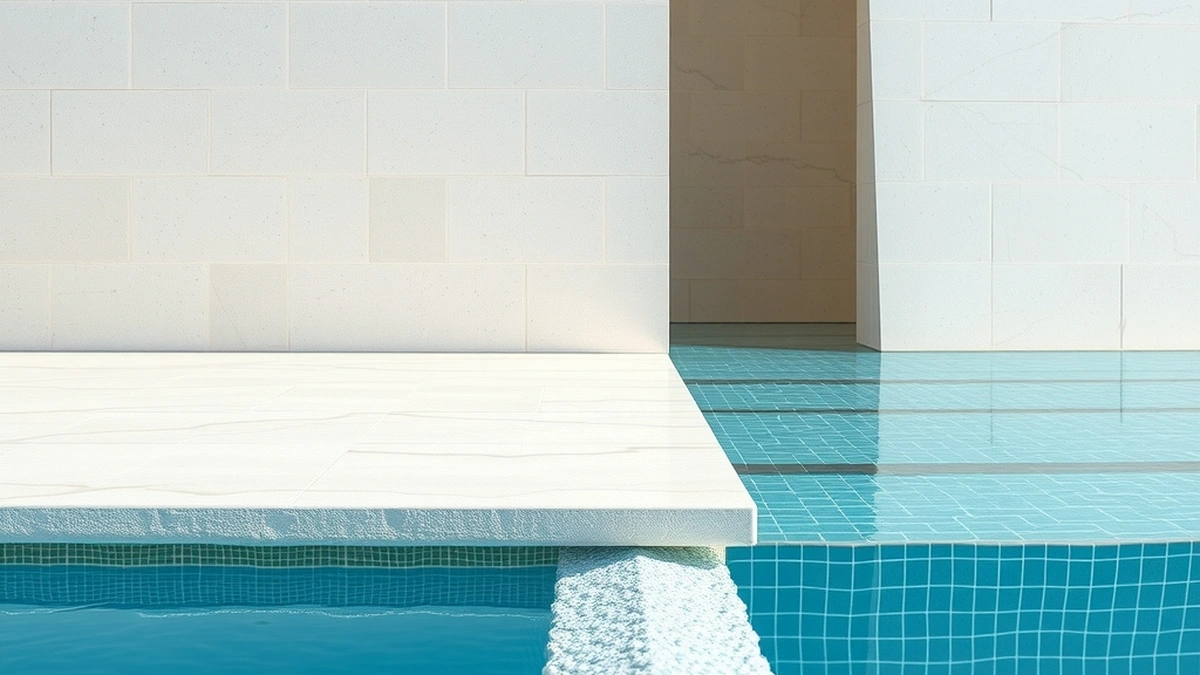
The signs of calcium scale are a rough white film at the waterline, a gritty feel on the tile, cloudy water that will not clear, a heater that rumbles, and white deposits on fittings. A fingernail catches on scale and passes over a stain.
- First sign
- White film at the waterline
- Texture test
- Fingernail catches
- Confusion with
- Etching and staining
- Removal cost
- $40 - $1,200
Some links on this page are affiliate links.If you buy through them we may earn a commission at no extra cost to you. We do not accept payment for rankings. Read the full disclosure.
Calcium scale shows up first where water evaporates, so the waterline is the place to look. A white or grey film that feels rough and catches a fingernail is scale. The same deposit on plaster makes the surface feel like sandpaper, and the same chemistry scales the heater and the salt cell.
The signs and where they appear
| Sign | Where | What it indicates |
|---|---|---|
| White film at the waterline | Tile and plaster edge | Scale forming |
| Hard crystalline line on tile | Waterline | Established deposit |
| Gritty plaster | Walls, floor | Scale over a wide area |
| Cloudy water that will not clear | Whole pool | Suspended calcium or high pH |
| White crust on fittings | Returns, ladders | Localised deposit |
| Rumbling or knocking heater | Equipment pad | Scaled element |
| Reduced salt cell output | Controller | Scaled electrodes |
The last two are the equipment version of the same problem, and they are the most expensive if ignored.
The fingernail test
Scale is a deposit sitting on the surface. Etching is a loss of material. They look similar in a photograph and behave differently under a fingernail.
Drag a nail across the mark. On scale, the nail catches on a raised edge and a little white material may come away. On etching, the nail passes over or drops into a shallow hollow, and nothing comes off.
That single test separates two problems with opposite treatments. Scale needs removal; etching needs a resurface. Treating etching as scale makes it worse, because the acid used to remove scale removes more cement.
Waterline film and the crystalline edge
The waterline is the diagnostic zone. Water evaporates there, leaving minerals behind, and the concentration rises before it rises anywhere else in the pool.
Early scale is a chalky film that wipes off with a cloth. Left for a season, it becomes a hard line with a crystalline edge that has to be scraped or dissolved. The difference between the two is a winter of neglect.
Wipe the tile with a cloth at the end of each week and look at what comes off. A white residue on the cloth is the earliest warning available.
Cloudy water and gritty plaster
Cloudy water has several causes, and scale is one of them. When the water is supersaturated, calcium can precipitate as fine particles that stay suspended and make the pool look milky. Distinguish it from algae and debris by testing: if chlorine is normal, the filter is clean, and the cloudiness persists while pH and calcium are high, the water is precipitating calcium rather than growing something. The fix is to lower pH and, if hardness is high, dilute with a partial drain and refill, which drops the concentration in proportion to the water replaced.
Scale on plaster is a haze that is easy to miss in the water and obvious to the hand. Run a palm along the wall at the shallow end: a scaled surface feels like fine sandpaper, and a sound one feels smooth.
That roughness is the same texture that traps dirt and makes brushing less effective, which is why a scaled pool needs more chlorine for the same result. The surface and the chemistry decline together.
Equipment signs
A scaled heater rumbles or knocks as it runs, and it takes longer to raise the pool temperature. A scaled salt cell produces less chlorine, and the controller reports a low output even when the salt level is correct.
Both are the same deposit on a hotter surface. Descaling a heater is $150 to $600, and a salt cell is often replaced at $200 to $500. Those are the costs that make early detection worth the effort.
A scaled element also runs hotter than it should, because the deposit insulates it from the water. That shortens its life and raises the running cost, which is a second bill that never appears as a line item.
Five checks in five minutes
- Look along the waterline for a white film.
- Wipe the tile with a cloth and look at the residue.
- Drag a fingernail across the film to test for scale versus etching.
- Run a palm along the shallow end wall.
- Listen to the heater and check the salt cell output.
Step three decides the treatment, and step five decides whether the problem has already reached the equipment.
What the signs cost to act on
Early scale is a $40 to $120 hand treatment. Established scale on plaster is $300 to $1,200. Scale that has hidden etching underneath is a resurface at $4,000 to $10,000.
The interval between those numbers is one or two seasons, which is why the waterline wipe is worth doing weekly. A cloth and five minutes is the cheapest diagnostic in pool ownership, and it catches the problem while it is still a film.
The short version
White film at the waterline, grit on the plaster, cloudy water, and a rumbling heater are one problem in four places. Test with a fingernail to separate scale from etching, then treat accordingly. The removal methods are in calcium scaling: repair options, the prices are in calcium scaling: what a fix costs, and prevention is in calcium scaling: how to prevent it.
Frequently asked questions
How do I know if my pool has calcium scale?
Look at the waterline. A white or grey film that feels rough and catches a fingernail is scale. It appears first where water evaporates, and it does not brush off like a stain.
What does calcium scale look like?
A white, chalky, or grey deposit with a crystalline edge. On tile it forms a hard line at the water level; on plaster it looks like a haze that makes the surface feel like sandpaper.
How can I tell scale from etching?
Scale is raised and a fingernail catches on it. Etching is a hollow and the nail passes over or drops into it. Scale can be scraped off; etching cannot.
Why is my pool water cloudy?
Cloudiness can be scale particles, dead algae, or fine debris. If the cloudiness persists with normal chlorine and the waterline is scaled, high calcium or high pH is the likely cause.
Does scale affect the heater?
Yes. Scale forms on the heater element because it is the hottest surface, and it reduces efficiency and produces a rumbling sound. Descaling a heater is $150 to $600.
Can scale be removed without draining?
Light scale on tile can be removed by hand with a pumice block and a remover at $40 to $120. Scale on plaster usually needs draining for mechanical removal at $600 to $1,200.
Sources
Some links are affiliate links.If you buy through them we may earn a commission at no extra cost to you. We do not accept payment for rankings. Read the full disclosure.