Staining: warning signs that tell you the cause
Brown streaks, blue-green marks, white film, and tan leaf shapes each point to a different pool stain. Read the colour and pattern before buying any chemical.
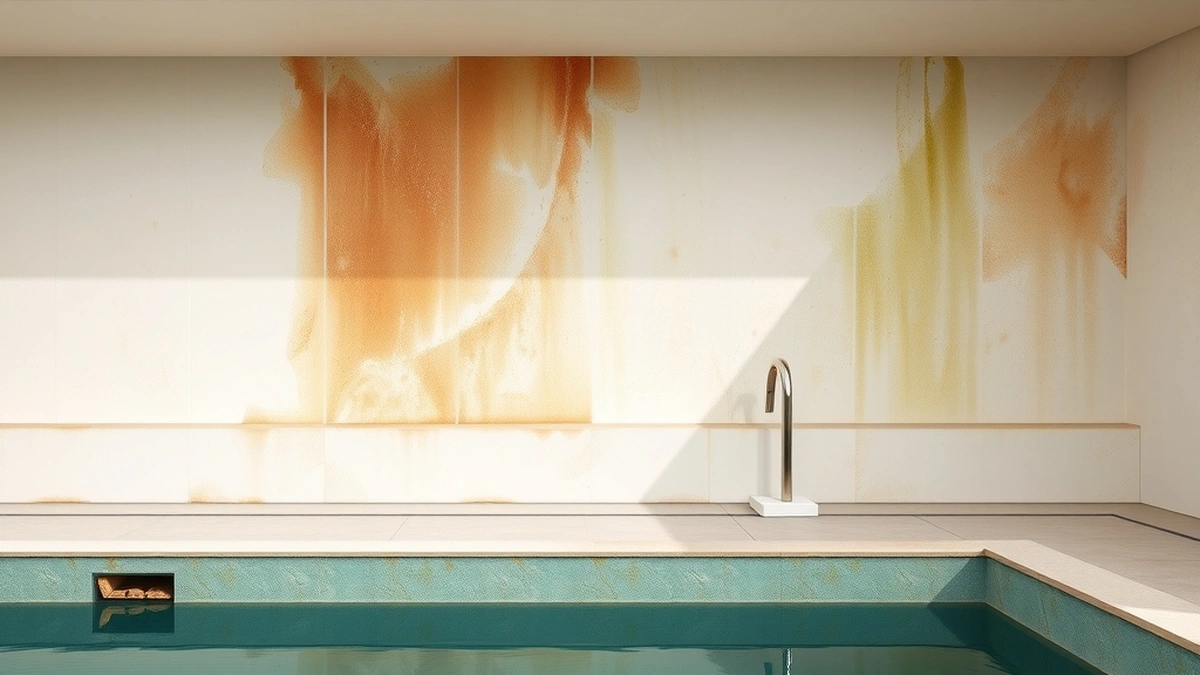
Brown streaks point to iron, blue-green marks to copper, white film to calcium scale, and tan leaf-shaped marks to organic debris. The colour and pattern narrow the cause before a vitamin C tablet confirms it.
- Iron stain
- Brown or rust streaks
- Copper stain
- Blue-green or grey
- Scale
- White, rough film
- Organic
- Tan, leaf-shaped
Some links on this page are affiliate links.If you buy through them we may earn a commission at no extra cost to you. We do not accept payment for rankings. Read the full disclosure.
Pool stains announce their cause through colour and pattern. Brown or rust-coloured streaks are iron, blue-green or grey marks are copper, a white rough film is calcium scale, and a tan mark shaped like a leaf is organic. Reading the signs narrows the treatment to one of four, and a vitamin C tablet confirms it in a minute.
Colour, pattern, and placement
| Appearance | Likely cause | Where it appears | Test |
|---|---|---|---|
| Brown or rust streaks | Iron | Waterline, return path | Vitamin C lifts it |
| Blue-green or grey | Copper | Walls, steps, fittings | Vitamin C lifts it |
| White rough film | Calcium scale | Waterline, tile, walls | Fingernail catches |
| Tan leaf shapes | Organic debris | Floor, steps | Chlorine puck lifts it |
| Dark grey blotches | Organic, old | Corners, low flow | Chlorine, slow |
| Black spots | Organic, algae | Walls, seams | Chlorine, brushing |
Placement matters as much as colour. A stain in the path of a return is being deposited by the flow; a stain in a corner is sitting where the water does not move. The first is a chemistry problem, the second is a circulation problem.
Brown and rust marks
Iron is the most common metal stain, and it has a signature look: brown, orange, or rust-coloured streaks that follow the waterline or fan out from a return fitting.
The timing is often the clue. Iron sits dissolved in the water until a heavy chlorine dose oxidises it, and the stain appears within a day of the shock. Owners frequently describe it as appearing overnight, which is exactly what happened.
Sources are the fill water, a corroding heater, and galvanised fittings. A metals test on the fill water tells you which.
Copper stains read blue-green, teal, or dark grey depending on concentration and surface. They often concentrate around fittings and on the steps, and the water itself can take on a green tint when copper is high.
The usual source is a heater with a failing core, though copper piping and some algaecides also contribute. Copper staining is often accompanied by a chlorine demand that will not settle, because the metal is consuming chlorine.
White film, tan shapes, and dark blotches
Scale is not a stain in the same sense. It is a deposit sitting on the surface, and it feels different. Drag a fingernail across it and the nail catches on a raised film; a true stain is in the plaster and the nail passes over it.
Scale forms when pH and calcium hardness are high, and it concentrates at the waterline where evaporation leaves minerals behind. On tile it is a hard white line; on plaster it is a grey-white haze that makes the surface feel like sandpaper.
Organic stains are the easiest to read because they take the shape of the debris. A fallen leaf leaves a leaf-shaped mark, a seed pod leaves a pod-shaped one, and a pile of leaves leaves a dark patch with a soft edge.
They lift with oxidation. Shock the pool, brush, and keep the chlorine at the high end of the range for a few days. A stubborn mark can be tested with a chlorine puck, which lightens it in a minute.
Black spots are a different organic problem: they are usually algae in a seam or a pit, and they need brushing and sustained chlorine rather than a one-off dose.
The two tests that settle it
Hold a vitamin C tablet against the stain for a minute. If the mark lifts, it is metal, and the treatment is ascorbic acid plus a sequestering agent.
Hold a chlorine puck against a different spot for a minute. If that lifts, the stain is organic, and the treatment is shock and brushing.
If neither works, the mark is scale or an etched hollow. That changes the answer from chemistry to mechanical removal or resurfacing.
A stain on a failing surface
A stain that sits on sound plaster is a deposit. A stain in a chalky, pitted, or hollow-sounding surface is a symptom of a failing finish.
A stain that sits on sound plaster is a deposit. A stain in a chalky, pitted, or hollow-sounding surface is a symptom of a failing finish.
Test the surface around the mark. Rub it with a wet hand: chalk on the palm means the cement is dissolving. Tap it with a screwdriver handle: a hollow note means the plaster has separated from the shell. At that point the stain is secondary, and the repair is a resurface rather than a treatment. The decision tree is in staining: repair options and the price comparison is in staining: what a fix costs.
Four checks before buying anything
- Note the colour and the shape of the mark.
- Note where it sits: waterline, return path, corner, or floor.
- Run the vitamin C test.
- Run the chlorine puck test.
Four checks, ten minutes, and no chemicals bought on a guess. That is the whole diagnostic method.
The short version
Colour points to the cause, placement points to the source, and the tablet test confirms it. Brown is iron, green is copper, white is scale, tan is organic. Treat the cause, not the colour, and read the surface before assuming the stain is the problem. Prevention is in staining: how to prevent it.
Frequently asked questions
What do brown stains in a pool mean?
Usually iron. It appears as brown or rust-coloured streaks, often at the waterline or in the path of a return, and it often shows up the day after a heavy chlorine dose oxidises dissolved metal.
What causes green stains on a pool surface?
Copper, typically from a heater or from fill water. Copper stains read blue-green to grey, and they are often accompanied by green tinted water when the concentration is high.
How can I tell scale from a stain?
Scale is raised and rough. Drag a fingernail across it and the nail catches on a deposit. A stain is in the surface rather than on it, and the nail passes over it.
Why are my stains leaf-shaped?
Because they are organic. A leaf that sits on the bottom or the steps leaves a tan mark in its own shape. Those marks lift with shock and brushing rather than with a metal treatment.
Do stains always mean the surface is failing?
No. Most are deposits on sound plaster. A stain that is accompanied by chalky plaster, pitting, or a hollow sound when tapped is a sign the surface itself is going.
When should I test rather than guess?
Before buying any chemical. A vitamin C tablet and a chlorine puck cost cents and separate metal from organic in a minute, which is the difference between the right treatment and a wasted $100.
Sources
Some links are affiliate links.If you buy through them we may earn a commission at no extra cost to you. We do not accept payment for rankings. Read the full disclosure.