Fibreglass problems: blisters, crazing, lifting
Osmotic blisters, gelcoat crazing, chalking, and lifting edges on fibreglass pool finishes, with the causes, the checks that confirm each, and repair costs.
Fibreglass pool problems are mostly moisture and bond failures: osmotic blisters from water under the gelcoat, crazing from cure stress, and lifting edges from poor prep. Small areas repair; widespread blistering means a new overlay.
- Service life
- 10-15 years
- Overlay cost
- $5,000-$12,000
- Spot repair
- $300-$1,500
- Most common fault
- Osmotic blistering
Some links on this page are affiliate links.If you buy through them we may earn a commission at no extra cost to you. We do not accept payment for rankings. Read the full disclosure.
Fibreglass pool problems are mostly moisture and bond failures. Osmotic blisters form where water passes through the gelcoat and meets a void in the laminate, crazing forms where the resin cured under stress, and lifting edges form where the skin never bonded in the first place. Small areas repair for a few hundred dollars; widespread blistering is a new overlay at $5,000 to $12,000.
What a fibreglass finish is up against
A fibreglass overlay is a glass-reinforced resin skin sealed with a gelcoat, with a service life of 10 to 15 years. The gelcoat is the water-facing barrier, and it is thin — a fraction of a millimetre in places. Everything that goes wrong with fibreglass starts with that barrier being breached, thinned, or never properly formed.
Three conditions accelerate every one of the faults below: warm water, low pH, and time. A pool held at 7.0 for a season will show gelcoat damage that a balanced pool would not show in five years.
Osmotic blisters
Blisters are the signature fibreglass failure and the most expensive. They appear as raised bumps, often in clusters on the floor or along the waterline, and they can be hard or soft to the touch.
The mechanism is osmotic. Water vapour passes slowly through the gelcoat and reaches a void, a patch of uncured resin, or a pocket of water-soluble material in the laminate. Water accumulates in the void, pressure builds, and the surface lifts into a bubble. Warm water speeds the process, which is why heated pools blister first.
What to do about them:
- A few isolated blisters. Open each one, drain it, dry the area thoroughly, and fill with epoxy. Cost is modest and the repair is durable if the surrounding laminate is sound.
- Clusters in one area. The laminate under that area has taken on water. Grind back to dry material, dry it, and relaminate.
- Blisters across the floor and walls. The skin is saturated. Patch repairs will keep appearing elsewhere; a new overlay is the only sensible answer.
Crazing and hairline cracks
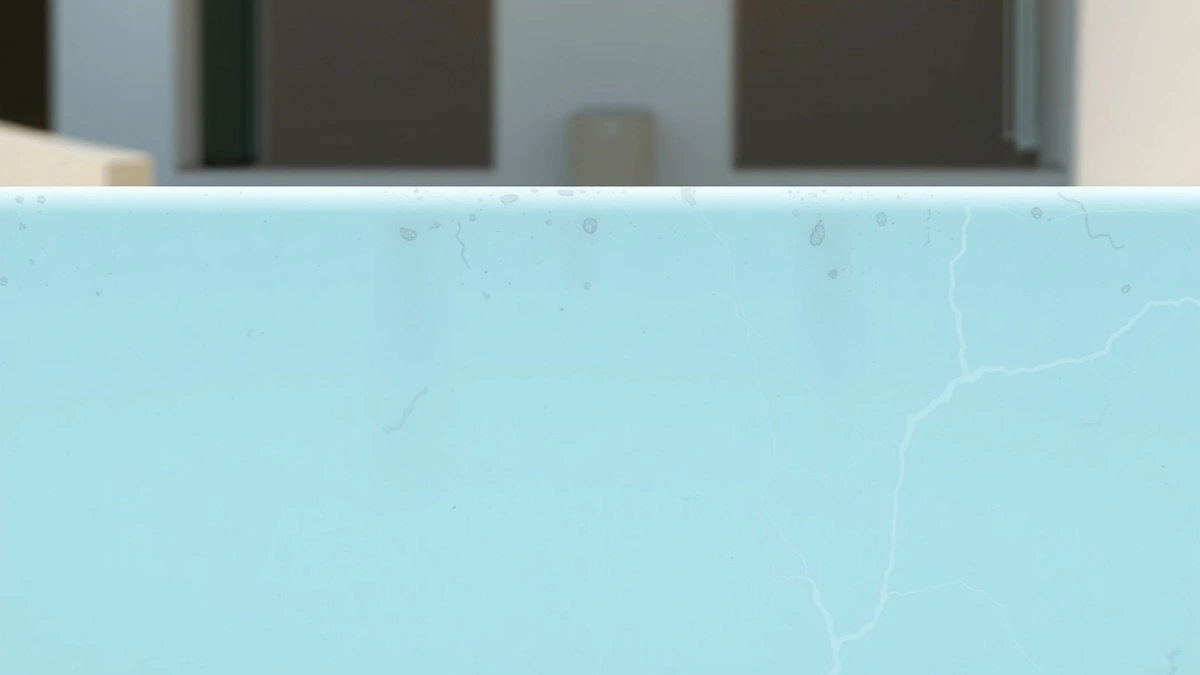
Crazing is a web of fine cracks in the gelcoat, like the surface of old pottery. It is usually visible only up close, and it is often the first thing an owner notices after a few summers.
Causes are almost always at installation: too much catalyst in the resin, gelcoat sprayed too thick, or curing at a temperature outside the resin’s range. Crazing that appears years later is usually gelcoat that has become thin and brittle.
Crazing is cosmetic until it is not. Each crack is a path for water into the laminate, and once water is in, blisters follow. A light grind and re-gelcoat over the affected area stops the progression; ignoring it for five years does not.
Chalking and colour fade
Gelcoat oxidises in sunlight. The visible result is a chalky film that comes off on hands, swimsuits, and pool toys, and a colour that has gone from blue to pale gray-blue.
This is normal ageing, not a defect. Light compounding with a fibreglass polish restores gloss for a season or two. When compounding no longer brings back the colour, the gelcoat is thin enough that the laminate underneath is close to exposed, and a re-gelcoat or overlay is the next step. Fibreglass maintenance covers the routine that slows it.
Lifting, soft spots, and delamination
Lifting shows as an edge of the skin standing away from the shell, usually at the waterline, around fittings, or where the floor meets the wall. Press on it and it moves; tap it and it sounds hollow.
Two causes dominate. The first is preparation: a shell that was not ground properly, or was damp when the resin went on. The second is water getting behind the skin through a crack, a fitting, or a light niche, and working the bond loose from behind.
| Problem | What you see | Cause | Realistic fix |
|---|---|---|---|
| Blisters | Raised bumps, clusters | Water in the laminate | Open and seal, or relaminate |
| Crazing | Fine web of cracks | Cure stress, thin gelcoat | Grind and re-gelcoat |
| Chalking | White film, faded colour | UV oxidation | Compound and polish |
| Lifting | Skin standing away | Poor prep or water behind | Cut out and relaminate |
| Soft spots | Give underfoot | Saturated or unbonded laminate | Structural repair |
| Stains | Brown or grey marks | Metals, organics | Acid-free stain treatment |
Repair or replace
- Dry the pool and mark every defect with chalk, photographing each area.
- Press and tap each mark to sort blisters from soft spots from crazing.
- Count the affected area as a share of the total surface, not as a number of spots.
- Get a quote for local repair and one for a full overlay, both with square footage stated.
- Compare the repair cost against the remaining life of the finish.
The arithmetic is blunt. A $1,200 repair on a twelve-year-old overlay buys three or four years at best; $5,000 to $12,000 buys ten to fifteen, or $333 to $1,200 per year. Once repairs pass a third of the overlay price, the overlay is the better spend. Fibreglass cost breaks that number down.
The short version
Fibreglass problems are barrier problems. Keep the gelcoat intact, keep the water balanced, and the finish reaches its fifteen years; let blisters or lifting spread and no patch will keep up. Diagnose by area rather than by spot count, and price the repair against the remaining life before deciding. The installation choices that prevent most of this are in fibreglass installation.
Frequently asked questions
What causes blisters on a fibreglass pool?
Water vapour trapped in the laminate. Water passes slowly through the gelcoat, meets voids or soluble material in the resin layer, and the pressure forms a bubble under the surface. Warm water accelerates it.
Are small blisters a serious problem?
Not immediately, but they do not heal. A few blisters can be drained and sealed. Widespread blistering across the floor and walls means the laminate has taken on water and needs replacement.
What is gelcoat crazing?
A network of fine cracks in the surface layer, usually from too much catalyst in the resin or from curing at the wrong temperature. It is cosmetic at first and becomes a water path over time.
Why is my fibreglass pool chalky?
Gelcoat oxidises under UV and sunlight, leaving a chalky film that wipes off on hands and swimmers. Light compounding restores the shine for a season or two; deep chalking means the gelcoat is thin.
Can a fibreglass pool be repaired or does it need resurfacing?
Local defects can be ground out, dried, and relaminated for $300 to $1,500. If blisters or lifting cover more than a small share of the surface, a new overlay at $5,000 to $12,000 is the cheaper route.
Does fibreglass delaminate like plaster?
It can, but the mechanism is different. Fibreglass lifts when the bond to the substrate never formed or when water gets behind the skin. Plaster fails by separating in sheets from the shell.
Sources
Some links are affiliate links.If you buy through them we may earn a commission at no extra cost to you. We do not accept payment for rankings. Read the full disclosure.