Quartz vs plaster: which pool finish fits
Quartz and plaster share a cement base but not a lifespan. Compare installed cost, cost per year, texture, and the pools where plaster still wins.
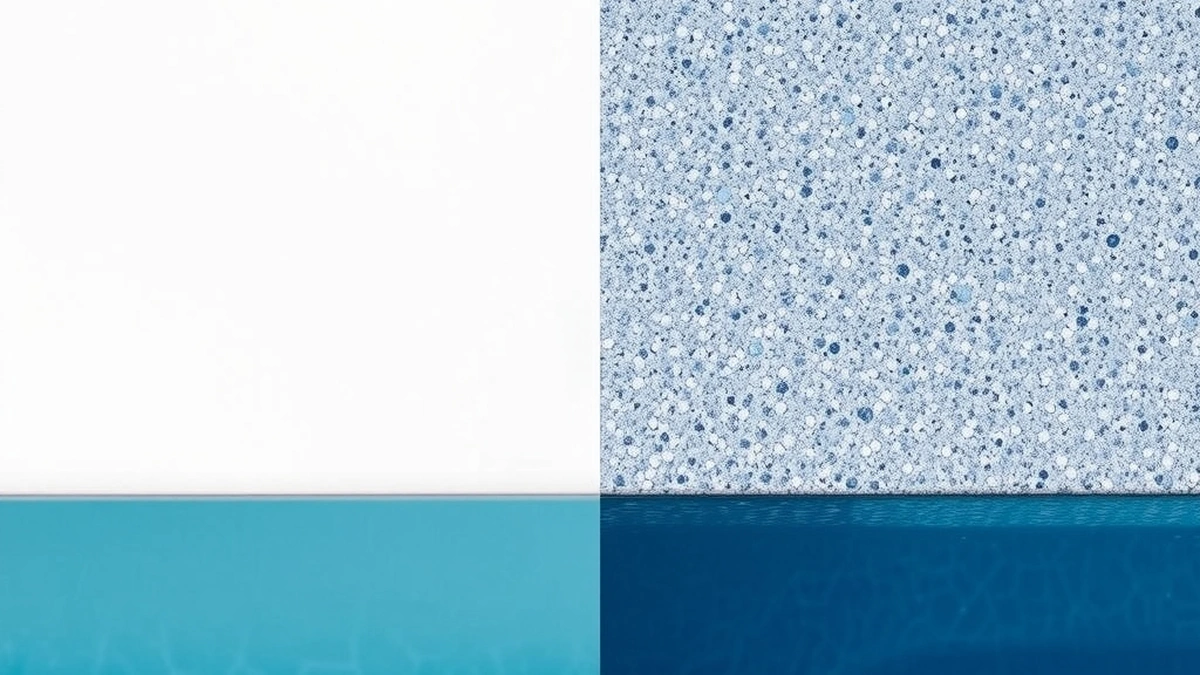
Quartz costs $6,000 to $12,000 and lasts 10 to 15 years; plaster costs $4,000 to $10,000 and lasts 7 to 12. Quartz wins on cost per year and surface hardness, plaster wins on upfront price and a smoother feel.
- Quartz installed
- $6,000-$12,000
- Plaster installed
- $4,000-$10,000
- Quartz life
- 10-15 years
- Plaster life
- 7-12 years
Some links on this page are affiliate links.If you buy through them we may earn a commission at no extra cost to you. We do not accept payment for rankings. Read the full disclosure.
Quartz is a plaster mix with crushed quartz aggregate replacing much of the marble dust; plaster is the same cement base without the hard aggregate. That one change raises the installed price by roughly $2,000 at both ends of the range, adds about three years of service life, and produces a surface that resists etching and hides staining better. Whether it is worth it depends on how long you plan to keep the pool.
The shared base, and where it splits
Both finishes are cementitious. Both are troweled onto the shell in coats, both cure for about 28 days, and both depend on water balance for their life. The difference is what sits at the surface after the cream is worked away.
Plaster exposes calcium carbonate, which is soft. Quartz exposes silica grains at Mohs 7, roughly four times harder than the material around them. When the water goes aggressive, plaster gives up calcium evenly across the whole surface and thins. Quartz gives up the cement paste between the grains first, which is why an old quartz pool can look sound and feel like sandpaper at the same time.
Cost, and the arithmetic that matters
Installed ranges for a typical residential pool:
- White plaster: $4,000 to $10,000
- Quartz aggregate: $6,000 to $12,000
The gap is $2,000 at the bottom and $2,000 at the top, so the premium is a fixed slice rather than a proportional one. What changes the comparison is life. Divide each range by its expected service life:
- Plaster: $4,000 ÷ 12 = $333 per year at best, $10,000 ÷ 7 = $1,429 per year at worst.
- Quartz: $6,000 ÷ 15 = $400 per year at best, $12,000 ÷ 10 = $1,200 per year at worst.
The ranges overlap heavily, which is the honest answer. Quartz is not reliably cheaper per year; it is cheaper per year on the mid and upper part of the price range and roughly equal at the bottom. What quartz does reliably is push the next resurface three years further out, and three years of not draining the pool has a value the table cannot show.
Side by side
| Aspect | White plaster | Quartz aggregate |
|---|---|---|
| Installed cost | $4,000-$10,000 | $6,000-$12,000 |
| Expected life | 7-12 years | 10-15 years |
| Cost per year | $333-$1,429 | $400-$1,200 |
| Surface feel | Smooth, soft | Fine grit |
| Stain visibility | High | Low |
| Low-pH tolerance | Poor | Moderate |
| Color choice | Limited, mostly white and tint | Wide, speckled |
| Repairability | Easy to patch, hard to blend | Easy to patch, patch is visible |
Two rows deserve a note. Stain visibility is the reason white pools photograph badly after five years: every leaf, every metal mark, every bit of scale shows. Quartz breaks that up. Repairability runs the other way — a plaster patch blends in because the surface is uniform, while a quartz patch shows as a smooth island in a speckled field.
Where plaster still wins
Plaster is the right answer more often than the upgrade pitch suggests:
- Short holds. If you are selling in two or three years, the $2,000 premium buys nothing you will recover.
- Rental and turnover property. A surface that will be repainted or replaced by the next owner does not need a 15-year life.
- Tight budgets with a sound shell. A $4,000 plaster job beats a deferred project, and a pool left empty and cracking costs far more later.
- Historic or uniform-white pools. Some pools look wrong in speckle, and a flat white surface is period-correct.
Plaster also takes a patch invisibly, which matters on a pool that gets fittings moved or a light relocated. The narrower argument for quartz is that a plaster pool costs $400 to $800 for an acid wash when it dulls, and acid washing removes surface material each time — it is maintenance that shortens the thing it cleans. See acid wash cost for what that buys and what it does not.
Where quartz wins
Quartz earns its premium in the pools that get used hard:
- Salt systems. A salt chlorinator run slightly hot produces aggressive water that eats plaster. Quartz holds up longer to the same drift.
- Full sun and heavy bather load. The denser surface resists the chalky wear that turns plaster rough in shallow areas.
- Long holds. Past ten years, the arithmetic tilts to quartz and stays there.
- Pools with a color scheme. Quartz comes in blue, gray, sand, and green mixes, and the speckle hides the mottling that tinted plaster shows badly.
If the choice is between quartz and pebble rather than quartz and plaster, pebble vs plaster covers the next step up, and quartz reviews collects what owners report after a decade of use.
Four steps to decide
- Write down how long you intend to own the pool. Under five years, take plaster.
- Get the interior square footage on each quote and divide the price by it. Two quotes without this number cannot be compared.
- Ask what removal method is included. A bond coat over failing plaster fails early regardless of the top coat.
- Divide the price by expected years of service, then decide whether the difference is worth the disruption of a second resurface.
Step four is where most homeowners switch to quartz. On an 800 square foot pool, $5,000 plaster over 9 years is $556 per year; $8,000 quartz over 13 years is $615 per year. That is $59 a year for a harder surface and no drain-down in year ten.
The startup decides the outcome
Neither finish reaches its expected life without the first month done properly. pH near 7.4, alkalinity at 80 to 120 ppm, calcium hardness high enough to keep the water from pulling calcium from the surface, and brushing twice daily for the first week. Heater off, no calcium hypochlorite shock, no waiting a week to test the fill water.
This is also why the cheaper quote is sometimes the expensive one. A $4,000 plaster job with no startup plan is $4,000 you will spend again. Pool resurfacing maintenance covers the ongoing side, and how long pool resurfacing lasts covers what shortens each finish.
The short version
Quartz and plaster are the same family of material with a different surface. Quartz costs $2,000 more, lasts about three years longer, hides stains, and tolerates chemistry drift better. Plaster is cheaper, smoother, and perfectly sound for a short hold or a tight budget. Buy quartz if you are keeping the pool; buy plaster if you are not; in both cases spend the difference on proper removal and a real startup plan.
Frequently asked questions
Is quartz better than plaster for a pool?
For most pools held longer than eight years, yes. Quartz costs $2,000 to $3,000 more upfront, lasts roughly three years longer, and resists low-pH etching better than a plain plaster surface.
How much more does quartz cost than plaster?
On the national ranges, quartz at $6,000 to $12,000 sits about $2,000 above plaster at $4,000 to $10,000 at both ends. The gap is small next to the difference in service life.
Which finish feels better underfoot?
Plaster is smoother. Quartz has a fine grit from the exposed aggregate. Neither is rough like pebble, but quartz is noticeable on steps and sun shelves.
Does quartz hide stains better than plaster?
Yes. The speckled surface breaks up light staining and mottling that shows plainly on white plaster, which is why white pools look older sooner.
Can you tell quartz and plaster apart visually?
Usually. Plaster reads as a flat, uniform color; quartz has visible grain and a slight sparkle in sun. From a distance the difference is mostly in how evenly the color sits.
Which finish lasts longer with poor water chemistry?
Quartz, but not by much. Both are cementitious and both etch at low pH. Neither tolerates a pool run at pH 7.0 for months, and pebble tolerates it better than either.
Sources
Some links are affiliate links.If you buy through them we may earn a commission at no extra cost to you. We do not accept payment for rankings. Read the full disclosure.