Rough or pitted plaster: repair options and what holds
Rough plaster is fixed by spot patching at $300 to $800, an acid wash at $400 to $800, or a full replaster at $4,000 to $10,000. Which one actually works.
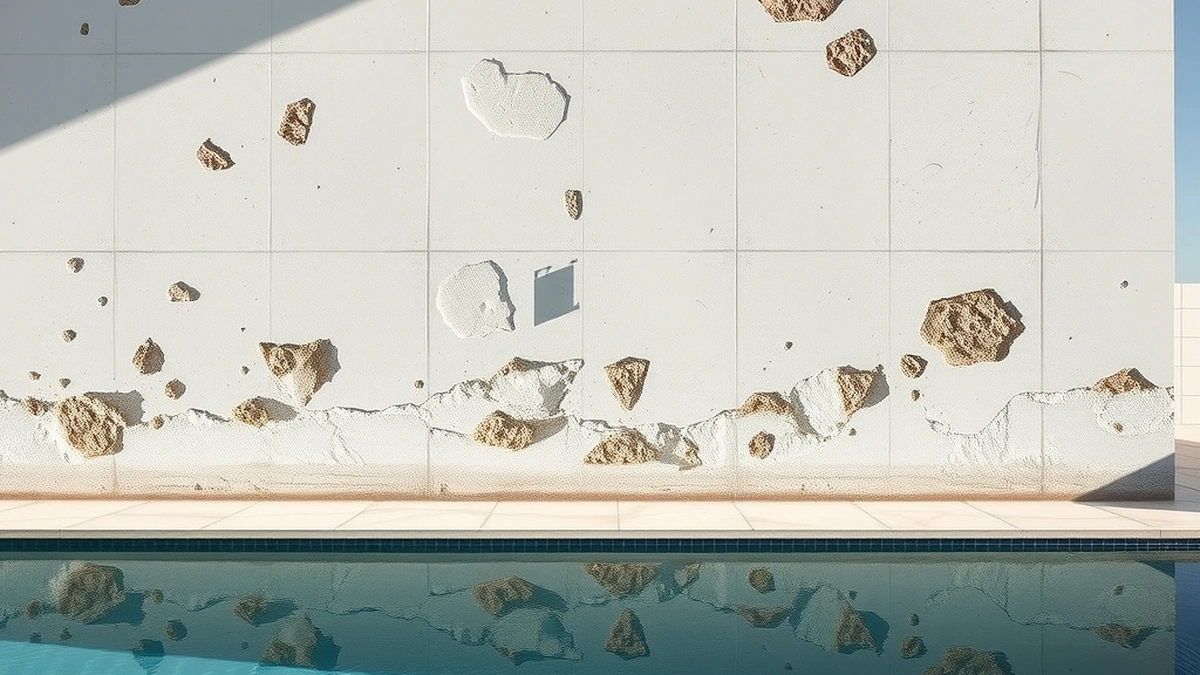
Rough or pitted plaster is repaired by spot patching at $300 to $800 if the damage is local, or a full replaster at $4,000 to $10,000 if it covers the pool. An acid wash at $400 to $800 removes stains but does not restore a rough surface.
- Spot patch
- $300 - $800
- Acid wash
- $400 - $800
- Full replaster
- $4,000 - $10,000
- Quartz upgrade
- $6,000 - $12,000
Some links on this page are affiliate links.If you buy through them we may earn a commission at no extra cost to you. We do not accept payment for rankings. Read the full disclosure.
Rough plaster is repaired in one of three ways, and only two of them work. A spot patch at $300 to $800 fixes localised pitting. A full replaster at $4,000 to $10,000 fixes a surface that has lost its matrix across the pool. An acid wash at $400 to $800 removes stains and does nothing for roughness, and it can make the surface rougher by opening the cement.
What rough plaster actually is
Plaster is a mix of cement and marble dust troweled onto the shell. The cement is the binder, and the marble dust is the filler. When the binder dissolves, the filler is left standing proud, and the surface feels like fine sandpaper.
That is the mechanism behind almost every rough pool. It is not wear in the sense of abrasion. It is chemical dissolution, and it happens when the water is aggressive: low pH, low alkalinity, or low calcium hardness.
The repair options
| Option | What it does | Best for | Cost |
|---|---|---|---|
| Acid wash | Removes stains, opens surface | Stained but sound plaster | $400 - $800 |
| Spot patch | New plaster over a prepared area | Under 10 sq ft of pitting | $300 - $800 |
| Bond coat and replaster | New finish over sound old | Widespread roughness | $4,000 - $10,000 |
| Full chip-out and replaster | Old finish removed entirely | Delamination or failed bond | $5,500 - $10,000 |
| Quartz resurface | Aggregate finish, longer life | Roughness plus a life upgrade | $6,000 - $12,000 |
| Tile replacement | Waterline only | Tile line damage | $1,500 - $5,000 |
The difference between the two replaster rows is preparation. A bond coat goes over the old surface; a chip-out removes it. The chip-out is more expensive and is the only correct choice when the old plaster is delaminating.
Why the acid wash is not a repair
An acid wash is a dilute acid application that dissolves a thin layer of plaster along with the stain. It is effective on metal staining, organic staining, and a light scale film.
It does not restore a rough surface. The roughness is the aggregate standing proud because the cement around it has gone. Acid removes more cement, not less, so a washed rough pool is often rougher afterward.
The $400 to $800 is still worth spending in one case: a stained pool whose plaster is otherwise sound, where the goal is appearance rather than texture. That is a maintenance decision, not a repair.
Spot patching, and when it is honest
A patch works when the damage is local: a few square feet around a fitting, a patch of pitting at the steps, a chip where something was dropped.
The area is drained, the loose material is removed to sound plaster, the edge is undercut, and a matching mix is troweled in and cured. The patch is visible but sound, and it costs $300 to $800 depending on access and area.
It stops being honest when the surrounding plaster is also rough. A patch bonds to what is around it, and if that is a chalky, failing matrix, the patch lifts within a season. Test the surrounding surface by rubbing it with a wet hand: if it comes away chalky, the whole surface is the problem.
Full resurfacing, and the preparation choice
A full resurface at $4,000 to $10,000 is the answer when roughness covers the floor and walls. The question inside that price is preparation.
A bond coat over sound plaster is cheaper and is a legitimate method. A chip-out removes the old finish to the shell, repairs cracks and hollow spots, and starts again. On a pool with any delamination, only the chip-out is correct, and the difference in price is $1,000 to $2,000.
Ask which one the quote includes. Two quotes that differ by $1,500 on the same pool are usually quoting different preparations, not different plaster.
What pitting looks like at the waterline
The waterline is where roughness usually appears first. The plaster at the top of the tile line is alternately wet and dry, and it is where splash-out concentrates the chemistry. Small pits appear as dark specks in a white surface, and they grow sideways as the cement around them goes.
That matters because the waterline is the cheapest place to catch the problem. A few pits at the top of the wall can be patched during a normal drain and refill, while the same process across the floor is a resurface. Check the waterline at the end of each season, before the pool is closed.
Six steps to decide
- Drain the pool or inspect at the waterline and steps.
- Rub the surface with a wet hand. Chalk on the hand means the matrix is failing.
- Tap the plaster with a screwdriver handle. A hollow sound means delamination.
- Measure the rough area. Under 10 square feet, patch.
- Over a quarter of the surface, plan a resurface.
- Ask each quote whether it includes a chip-out or a bond coat.
Step three is the one that decides between the two replaster methods, and it costs nothing.
The short version
Rough plaster is dissolved cement, not worn stone, and the fix is new plaster. Patch it when the area is small and the surrounding surface is sound; resurface it when the roughness is general. Skip the acid wash unless the problem is staining. Prices are in rough or pitted plaster: what a fix costs, prevention is in rough or pitted plaster: how to prevent it, and the assessment is in delamination signs.
Frequently asked questions
Can rough pool plaster be repaired without resurfacing?
Only if the damage is local. A patch at $300 to $800 works on a few square feet of pitting. Once the roughness covers the floor and walls, the surface has lost its cement matrix and a patch will not bond to it.
Does an acid wash fix rough plaster?
No. An acid wash at $400 to $800 removes stains and a thin surface layer, and it can make a slightly rough surface rougher by opening the cement. It is a cleaning step, not a repair.
What causes rough or pitted plaster?
Aggressive water is the usual cause. Low pH and low alkalinity dissolve the cement matrix and leave the aggregate standing proud. Pitting can also follow corrosion of embedded metal or a failed bond coat.
How much does it cost to fix pitted plaster?
A spot patch is $300 to $800. A full replaster is $4,000 to $10,000, or $4.68 to $11.70 per square foot on an 855-square-foot pool, and a quartz finish is $6,000 to $12,000.
How long does a plaster repair last?
A patch lasts as long as the surrounding plaster if the bond is good, which is usually three to six years on a surface that is already mid-life. On plaster near the end of its 7 to 12 year life, the patch outlives nothing.
Can I resurface over rough plaster?
Yes, with a bond coat, if the plaster is sound and not delaminating. Over active delamination the new finish fails with the old one, so the surface has to be tested before either method is chosen.
Sources
Some links are affiliate links.If you buy through them we may earn a commission at no extra cost to you. We do not accept payment for rankings. Read the full disclosure.